"Talking Points"

It was a privilege to speak to the Kiwanis Club of Monmouth, Illinois on January 15th. The subject? Photography, how I began and where it has taken me. I didn’t spot anyone with their eyes closed, so maybe the photos were interesting enough. I don’t mind speaking to a group about photography. It’s my passion. But I am not a great speaker. I usually “wing it,” and can be a bit scattered. Every group is different.

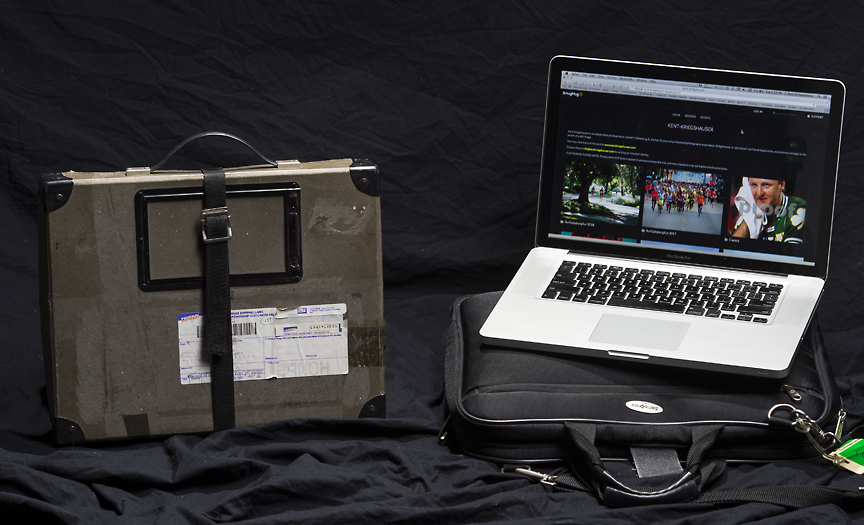
This venue had no means to use a screen or projector. And with the Kiwanis group being smaller than some, I decided to take the laptop computer and hold it for all to to view the photos, planning to gather the group tightly. More on how that worked out shortly.

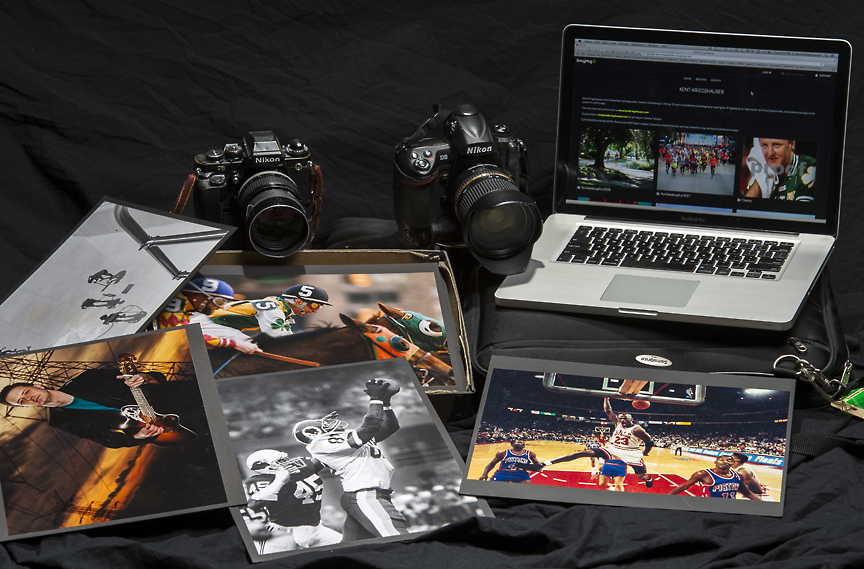
Also had the idea to take along a few props to show the group how much things have changed in a fairly short period of time. With me were a laptop computer, a Fiberbilt shipping case, one digital body with a newer lens, one film body with an older lens, and a 300mm 2.8 telephoto lens.

The laptop was to be used to view my primary web site. The Fiberbilt case housed older, mounted prints. A digital vs. analog thing. Guess what? The operating system in the old laptop wouldn’t allow that web site to load. How embarrassing! However, my secondary, SmugMug site, would load. Not all was lost.

“Show and tell” went reasonably well. Photos were held aloft. Many with a quick story behind them.

As the program progressed, it became MORE obvious to even me, how much has changed in aspects of the industry since I became a professional in 1983.

A photographer’s portfolio consisted of 20 or so prints, mounted on 11X14 matte boards. The prints served as a portfolio and may be used in contests. To make a perfect print, long hours were spent in a darkroom. It was not uncommon to spend one hour per print, to get the perfect combination of exposure, contrast, burning, and dodging. A lot of this went on after hours when one could have a darkroom all to their self. Setting up everything just right, maybe with music, and getting into a groove. Working late also prevented the supervisors know you were updating your portfolio and may be looking for another job!

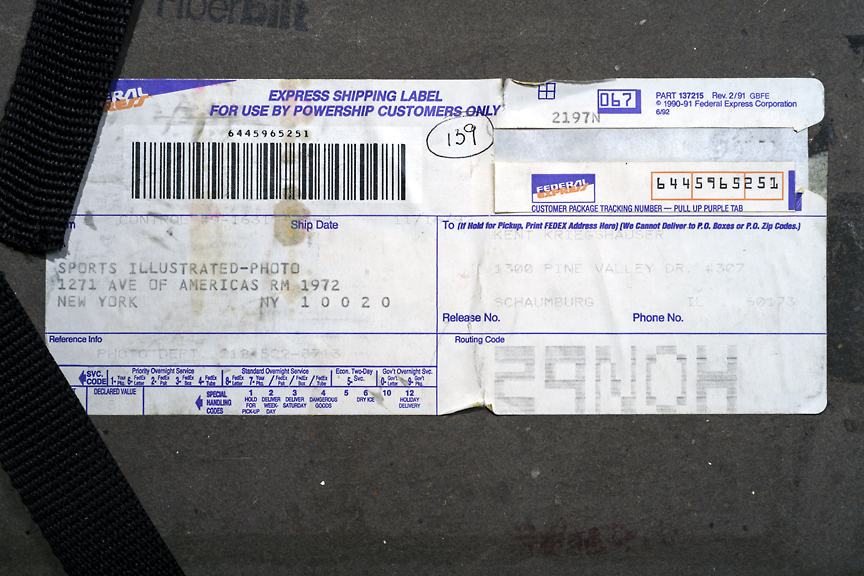
If you were applying for a job, your prints were shipped via the before-mentioned Fiberbilt case (see photos). Somewhat heavy. If it got lost, you were hosed. Ambitious photographers may have put in the hours in the darkroom to have two portfolios. This allowed to have two job applications out at the same time. Now? The sky is the limit. A web site is your portfolio. Apply for as many jobs as you want!

To learn of open positions, the two “go to” sources were Editor&Publisher magazine, and the National Press Photographer’s Association job bank. With the job bank, one would send five, self-addressed, stamped envelopes, and job postings would be sent weekly for those five weeks. Now? In most cases, one doesn’t even reach the photo department. Some human resources robot who might not know anything about photography, is weeding out applicants before the photo editor may lay eyes on a picture.

In “the day,” it was not uncommon to contact a publication in advance, to let them know you’d be passing through. Most all would receive you and review your work, even if there were no openings. The Chicago Tribune, Chicago Sun-Times, St. Louis Post-Dispatch, Dallas Times Herald, and Fort Collins Coloradoan, all gave me valuable feedback in such cases. These days, most aren’t receiving photographers, they are getting rid of them!

With today’s presentation, I was also able to point out the skyrocketing costs of equipment in this digital age. And why professionals have to ask what they do in rates.

The “good old days.” Things were more difficult. Tomorrow, I’ll take my digital cameras and make basketball photographs. I can see, almost instantly, if I got a “keeper” frame.

Oh well…Everything changes.
"Back to Work"

The first Monday of the new year. In the office and back to “full tilt boogie,” not that I haven’t spent plenty of time in the office during the holidays. I hope you had great ones. And there’s not a ton to report on. The work flow slowed down for about three weeks. Just checking in here.
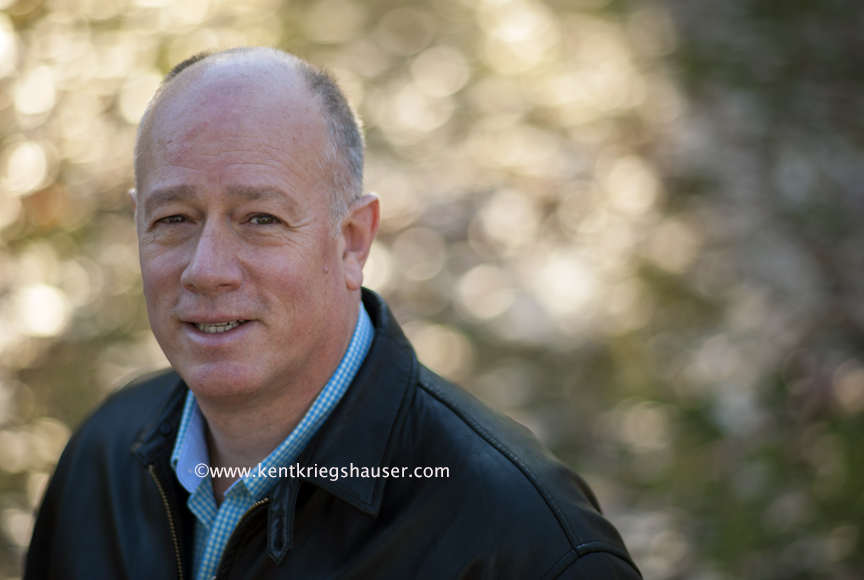
Photographed on Sunday, for a gentleman, Bradley Hix, who is running for alderman in Ward 1 in Galesburg. Family portraits, and other campaign style shots which will be used during the course of his campaigning. The weather was unseasonably fine. The portrait you see here, was made using an old, manually focusing, 105mm lens, with the aperture set at f2. Space was intentionally left on the right hand side of the fame for the option of adding text to the photo.

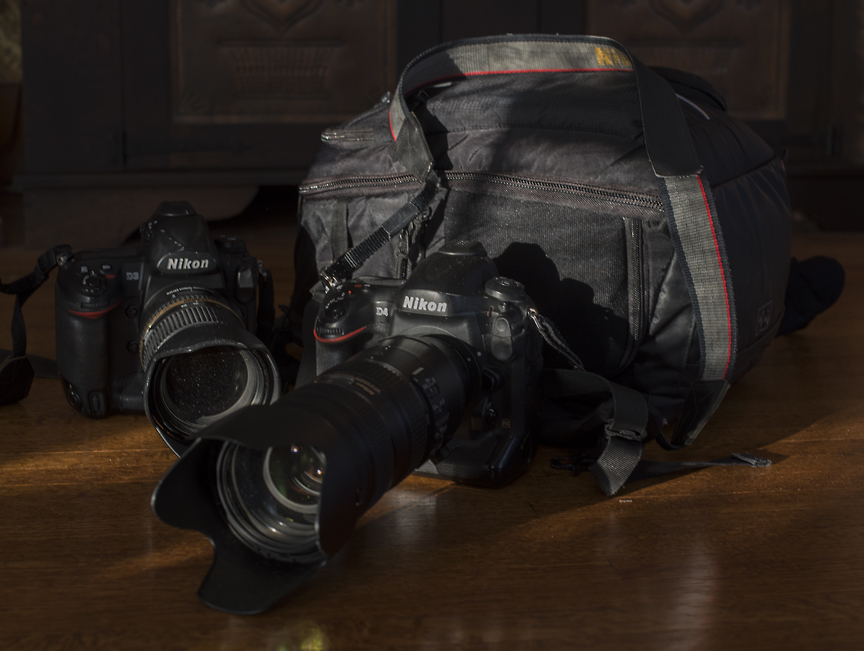
Am also on standby, in the “expectant photographer” role. Have been commissioned to photograph a birth. The second time to have this honor. And for the same family as the first. The due date is the 18th, but I’m traveling with my gear and keeping my phone nearby at all times now. The second photo illustrates what I’m packing around. When I posted of this upcoming work on facebook, it drew mixed reactions. Some thought it will be a great experience. Some were very turned off by the thought of a photographer at a childbirth. Each to their own. The late, great, photojournalist, Brian Lanker, won a Pulitzer Prize for a series on childbirth. Personally, I’d rather make photos of a baby being born than a fatal car accident, or someone’s home burning to the ground.

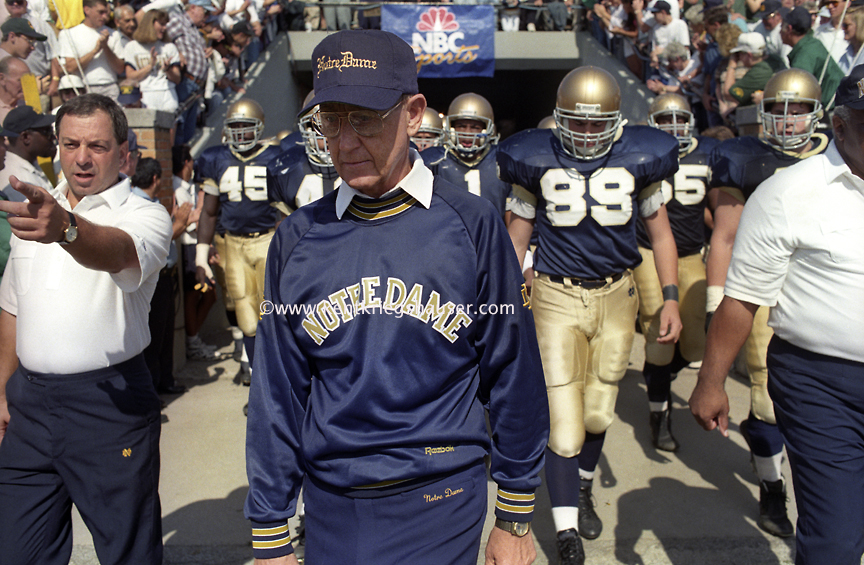
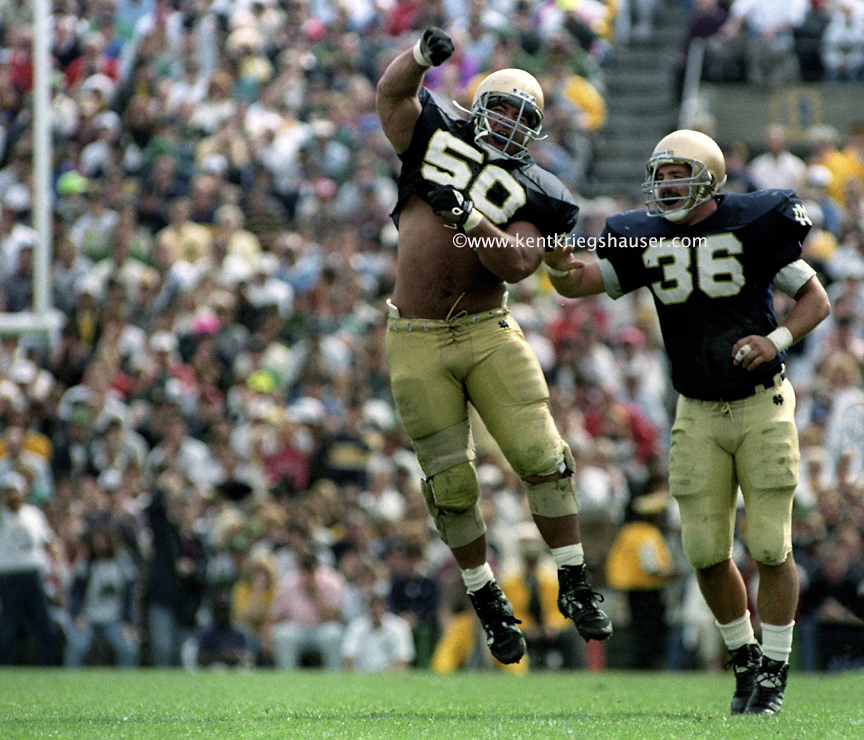
The holidays, and break during them, brought college football games playoffs. Made me think back to the days at The National Sports Daily, and how I photographed every home Notre Dame game. Would make the drive from Chicago to South Bend. Good times! So, here are two from the Fall of 1990. One of Lou Holtz leading the team to the field. And one of Chris Zorich and Don Grimm celebrating an interception.

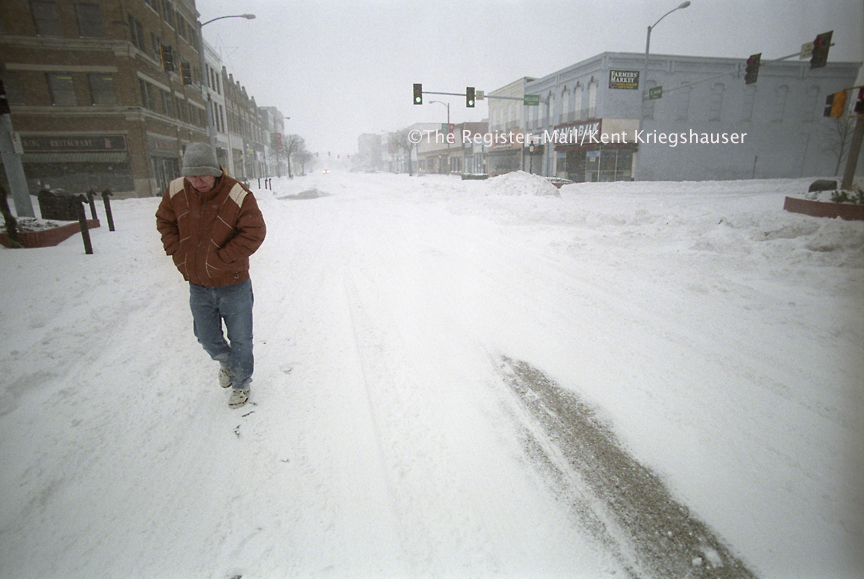
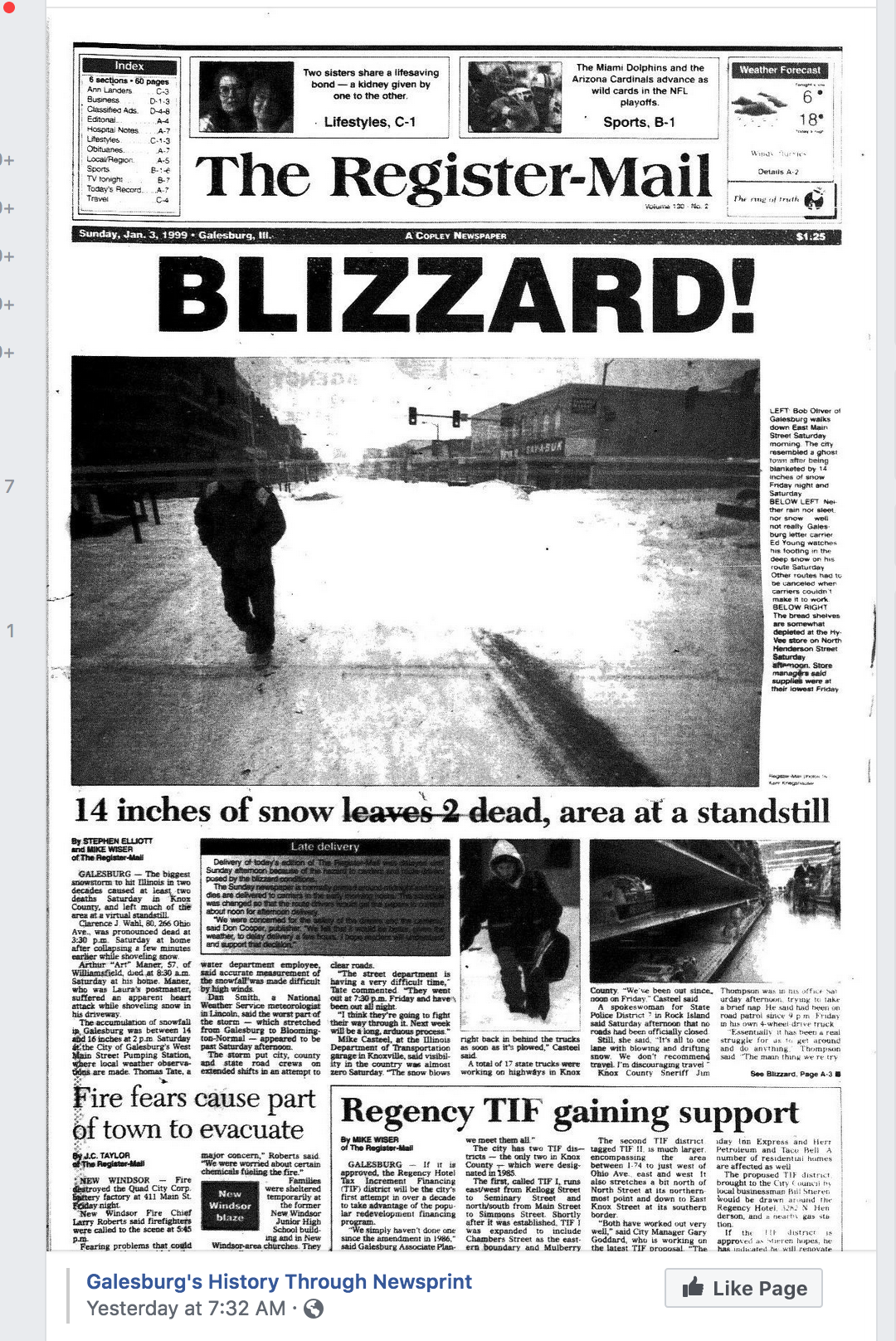
Lastly. The last publication I worked for as a staff photographer, The Galesburg Register-Mail, made a recent note of a huge blizzard that hit on January 2nd, of 1999. Approximately 20” of snow wound up on the ground. The snow began on Friday the 1st, but it was Saturday the 2nd when the photo in this blog was made. Galesburg was virtually shut down. I was out making photos and it was rough going to get around. I spotted this man, walking East on Main Street, and made some frames. After obtaining his name, I asked what brought him out in such conditions. He was walking to purchase a pack of cigarettes. I submitted this photo to the Associated Press and learned that a number of newspapers across the county had picked it up and published it. That always makes a photographer proud. You can see that the Galesburg paper ran it five and a half columns across the top of the front page.

So that’s what it’s all about for now. Waiting for things to pick up speed again. And reflecting back a bit on how fortunate I am to have the career I do, and what it allows me to witness.

"KGS Holiday Pops"

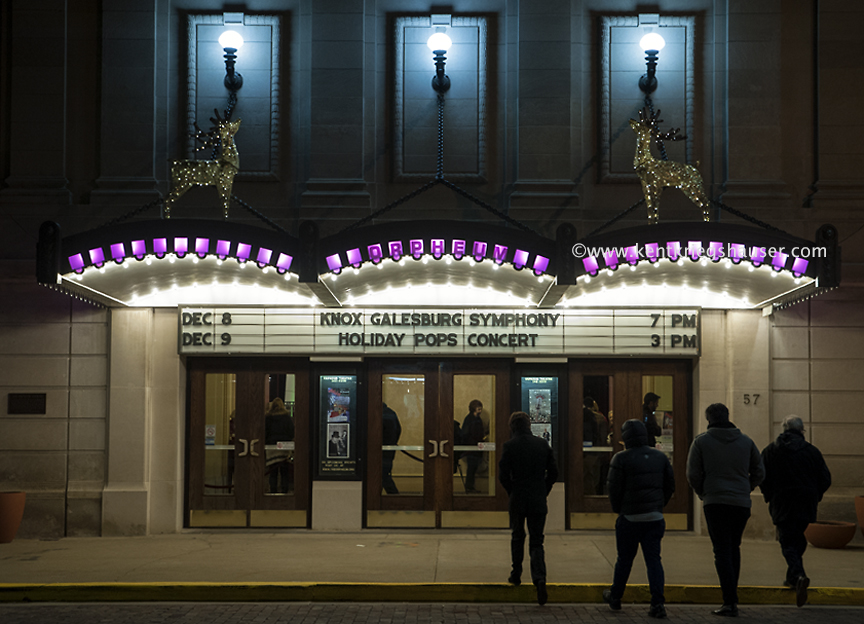
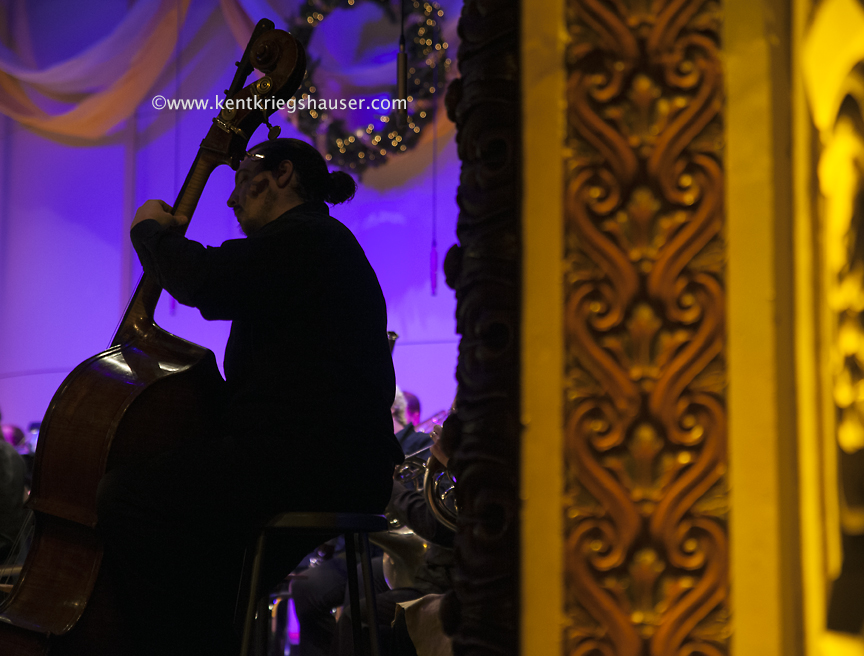
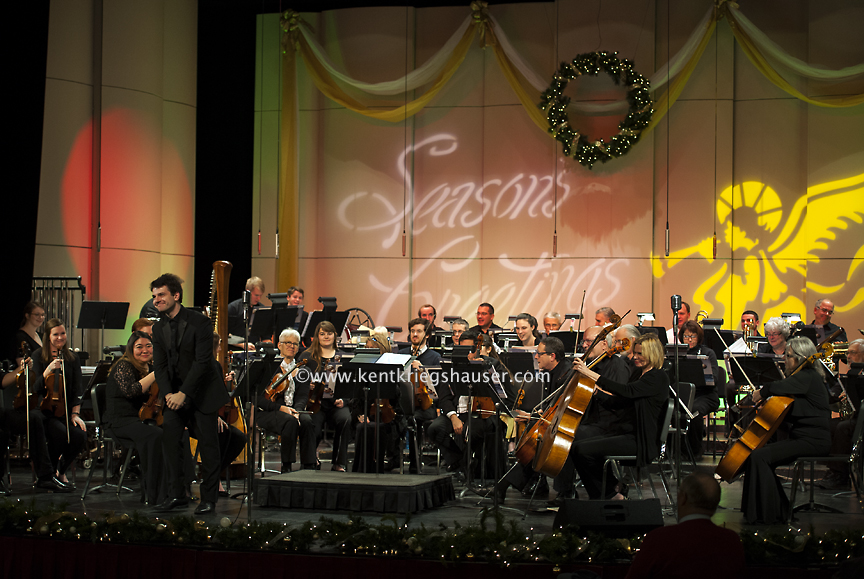
The Knox-Galesburg Symphony put me to work on Saturday night, December 8th, to photograph the first of two “seasonal” performances, the Holiday Pops Concert. The symphony uses my services from time to time. Its always a good experience, combining two of my loves. Music and photography. The symphony is very good at allowing me “artistic license,” and to be able to roam and have access to almost any area during the performance.

Photographing a symphony during its performance is not so easy. Most venues have great acoustics. And a symphony is not rock and roll. The sound of a camera shutter can easily be heard during quiet moments. And it’s distracting. A photographer has to be aware and respectful to the performers and audience. I do my best. They do make a device called a camera blimp that is said to reduce shutter noise by 99%. I have never used one. They can cost $1,000. That may be why I haven’t used one. A specialty item for sure.

Photographing a symphony is like photographing professional golf. There are moments it is fine to make a photo. And there are moments it isn’t. The quiet moments of the symphony are like the back swing of a tee shot. Quiet, please!

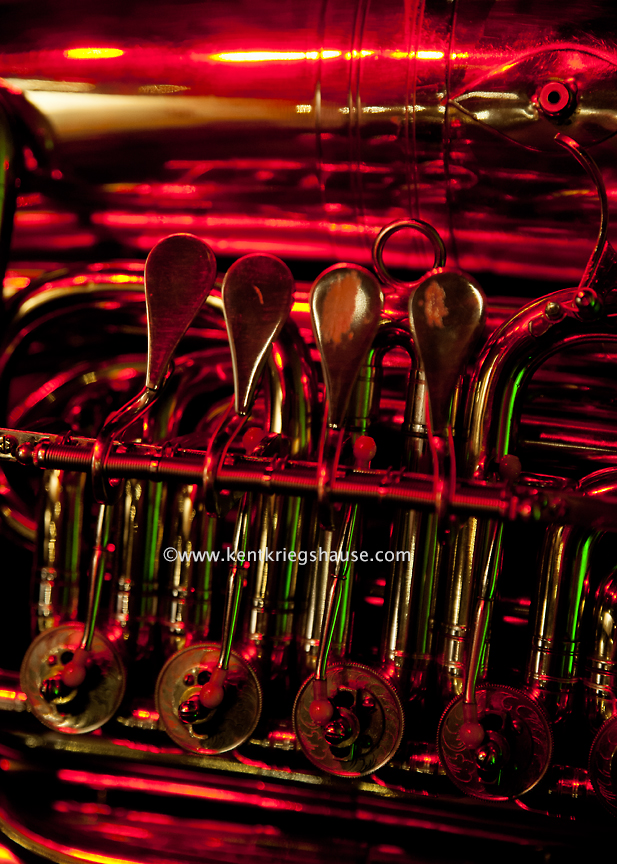
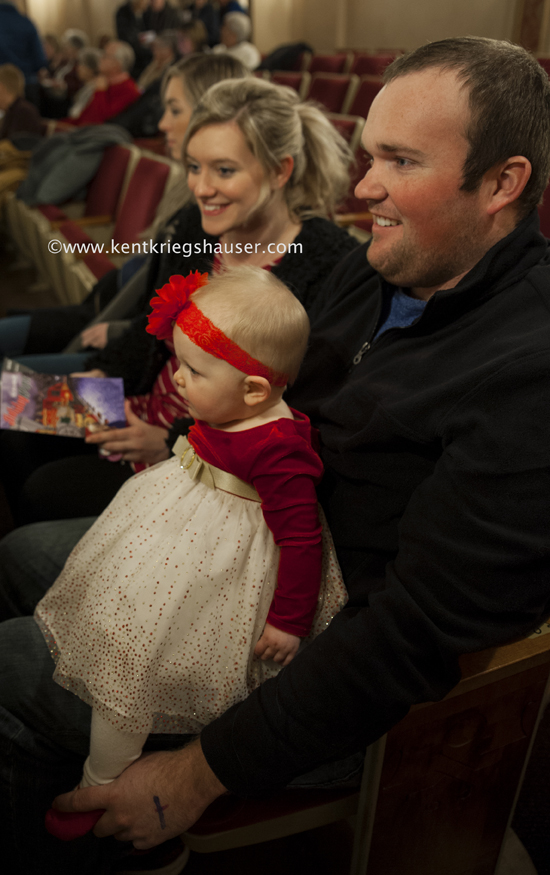
For the Holiday Pops Concert, with it being seasonal, my thought and goal was to make sure to make photos that show that it was! To use any color or decorations in the beautiful Orpheum Theatre, to tell the story that this show was different than any other symphony show. Using the two zoom lenses, and the 300mm 2.8 lens, I kept moving, and worked the theater from almost every angle. I have found one “sweet spot,” stage left and on the floor, where I can see most of the stage, but hide behind a wall and shoot through an opening. This position hides me, and reduces the shutter noise.

As I photographed the symphony on Saturday night I thought about the contrast of the beautiful music I was listening to, to the intensity of the music I was listening to exactly 39 years ago to the day. Saturday, December 8th, 1979. The International Amphitheater in Chicago. The Who!

"Three For the Scots"

Tuesday found me on the campus of Monmouth College in Monmouth, IL In terms of “volume,” I do a large amount of work for them. All aspects of photography. Editorial, sports, portraits, events. The Fighting Scots are very good to me! They support my business, and I’m grateful for that. Faculty and staff are fantastic. The students polite. And it’s always a good experience to go and make photos on the beautiful campus.

This recent trip over was a prime sampling of the type of work I do there. One sports portrait. A session that will make for a magazine cover. And the rededication of Grier Hall, a campus dormitory.

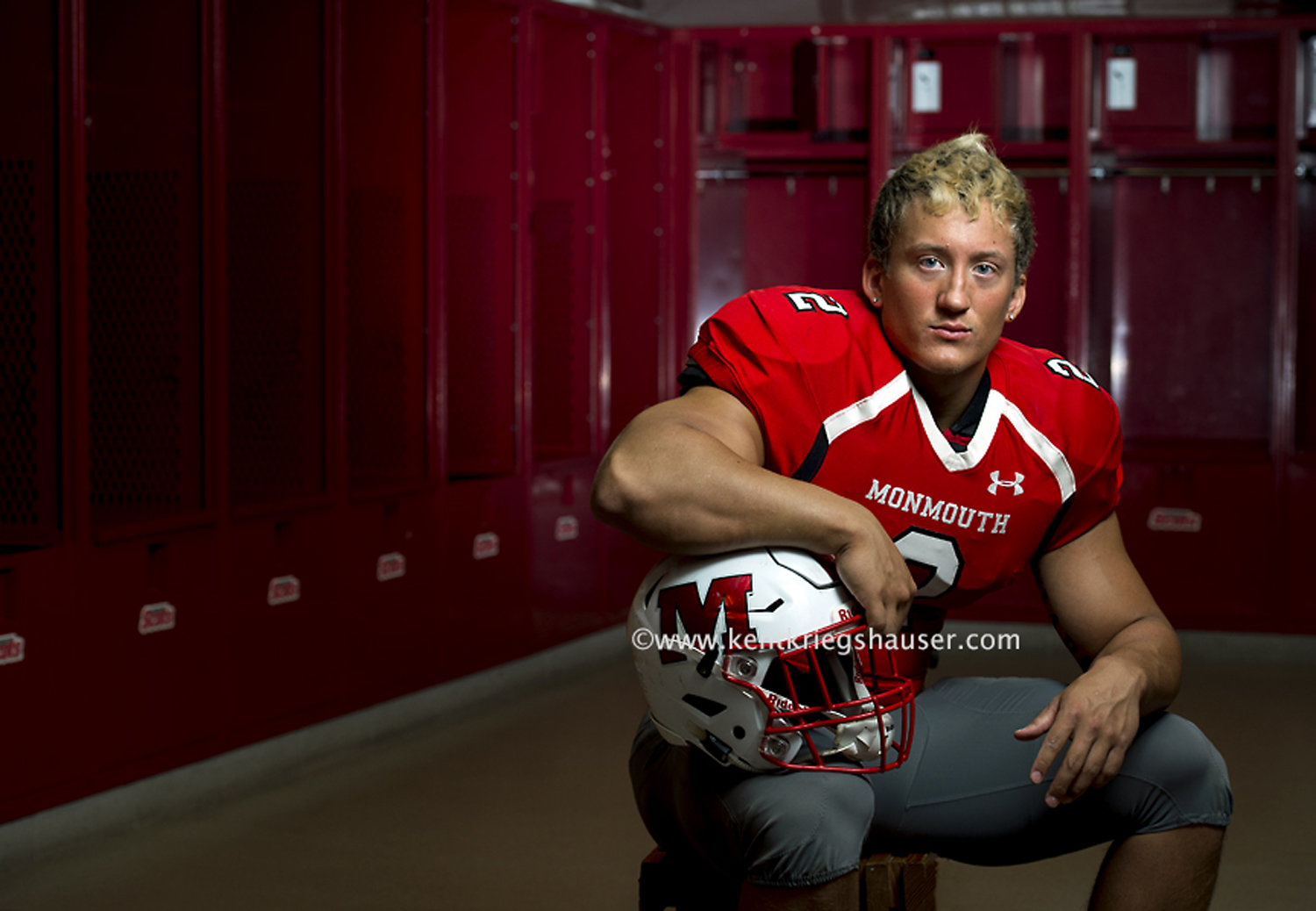
Thomas Lesniewski is a senior linebacker who will graduate mid-term. Portraits were needed to accompany a magazine story. Jeff Rankin, who coordinates a lot of the photography sessions, and myself, discussed ideas. With the unpredictable weather, we agreed upon the locker room. I began thinking of lighting set ups. Anywhere from two to three lights were used for the portraits. Speed lights. One shoot thru umbrella, One reflector umbrella, and a Rogue grid. Jeff sat in as my test subject. When Thomas walked in, we went to work. I was able to get 3-4 different lighting “looks” from one basic set up by moving lights, or shutting one down. One example is included in this blog.

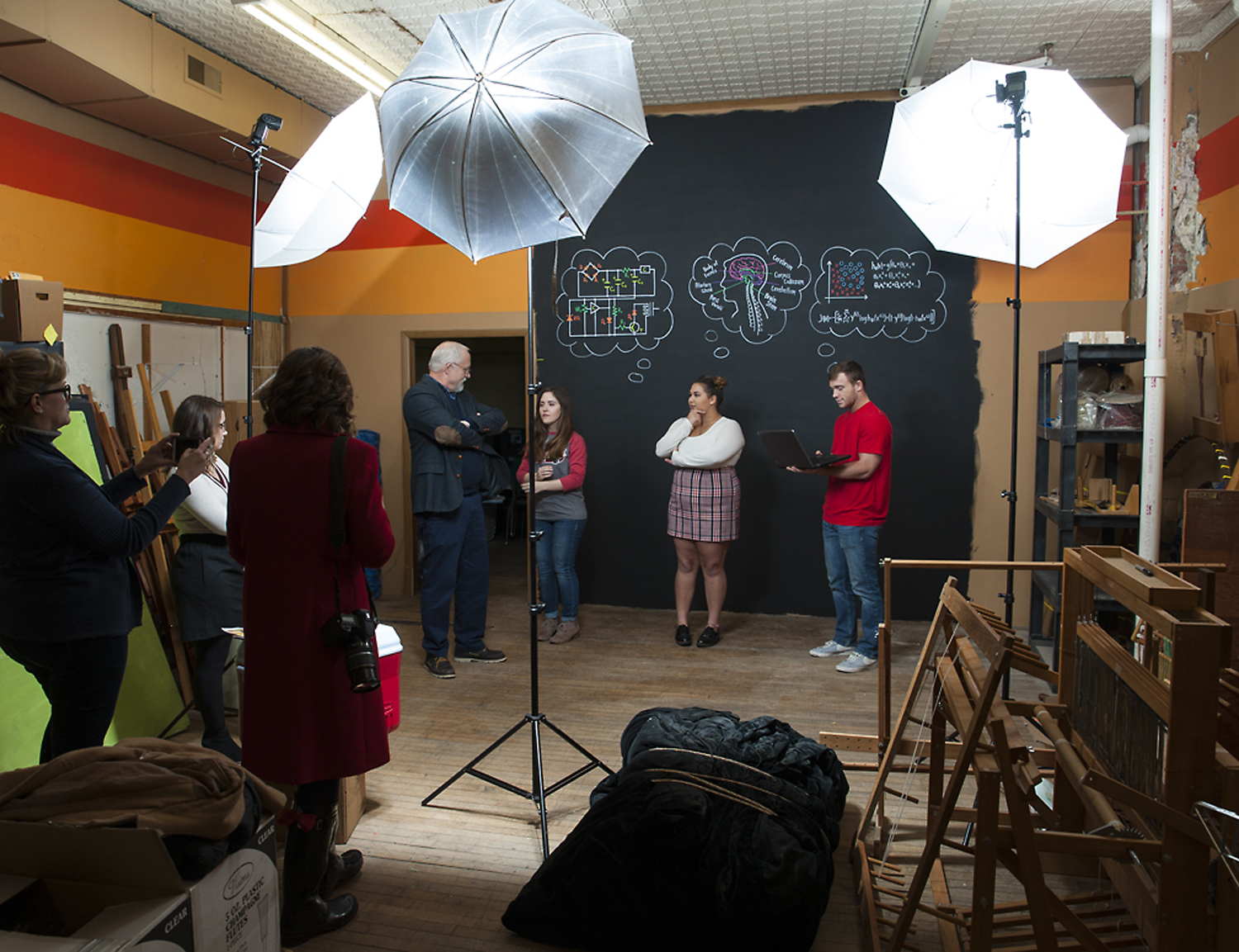
The next stop was the Buchanan Center for the Arts, second floor. The versatile Rankin had painted a wall black, Had artwork added, and secured students for the shoot, whom he directed. This session wasn’t too difficult. I mostly “pressed the shutter button.” A three light set up here, too. See the “behind the scenes” photo. Normally, the two outside umbrellas would be more to the outside, and behind the subjects to rim light them. Space, and a bad shadow on the background from the overhead heater, prevented that. Still. They were set “hotter” than the main light to give an extra kick.

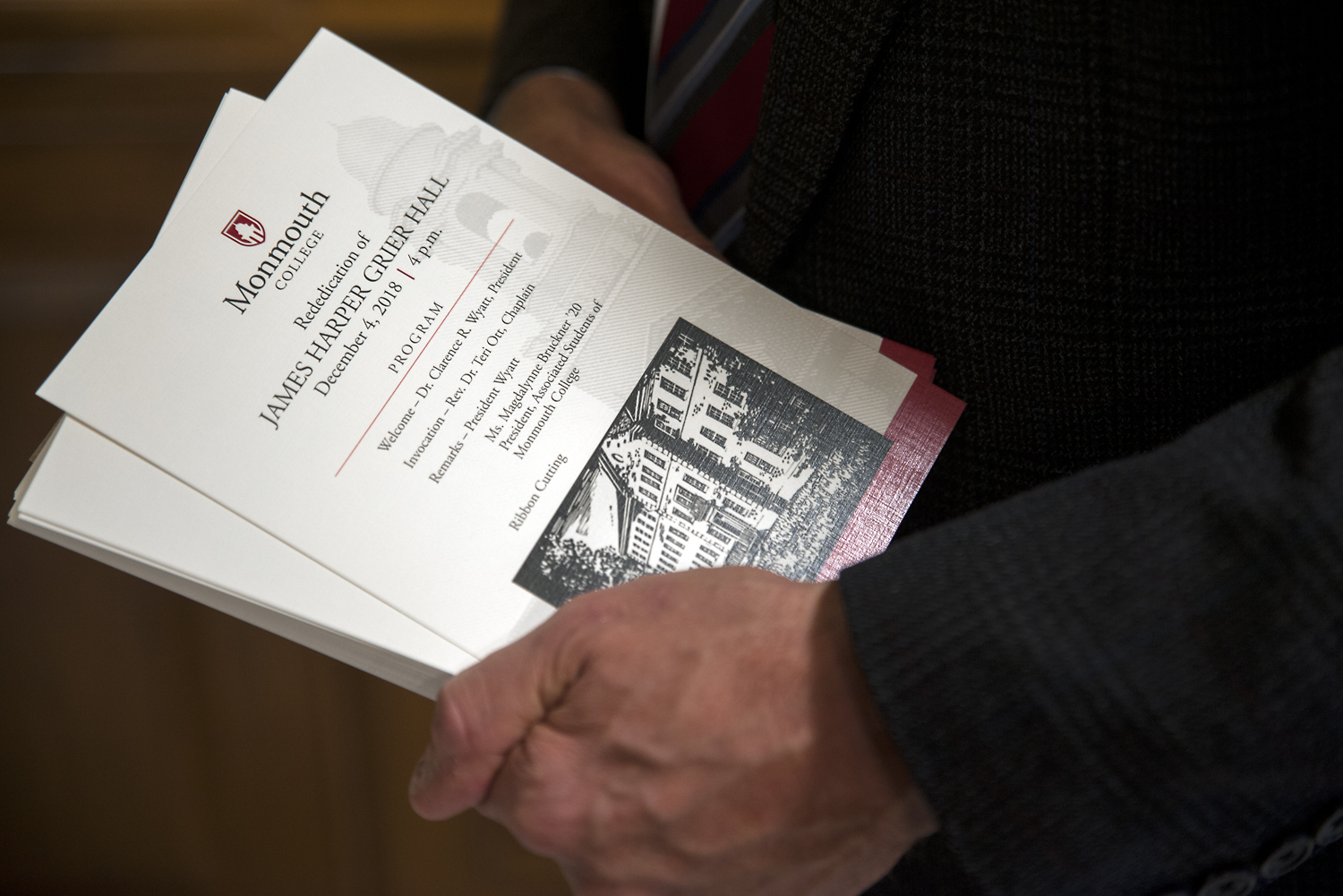
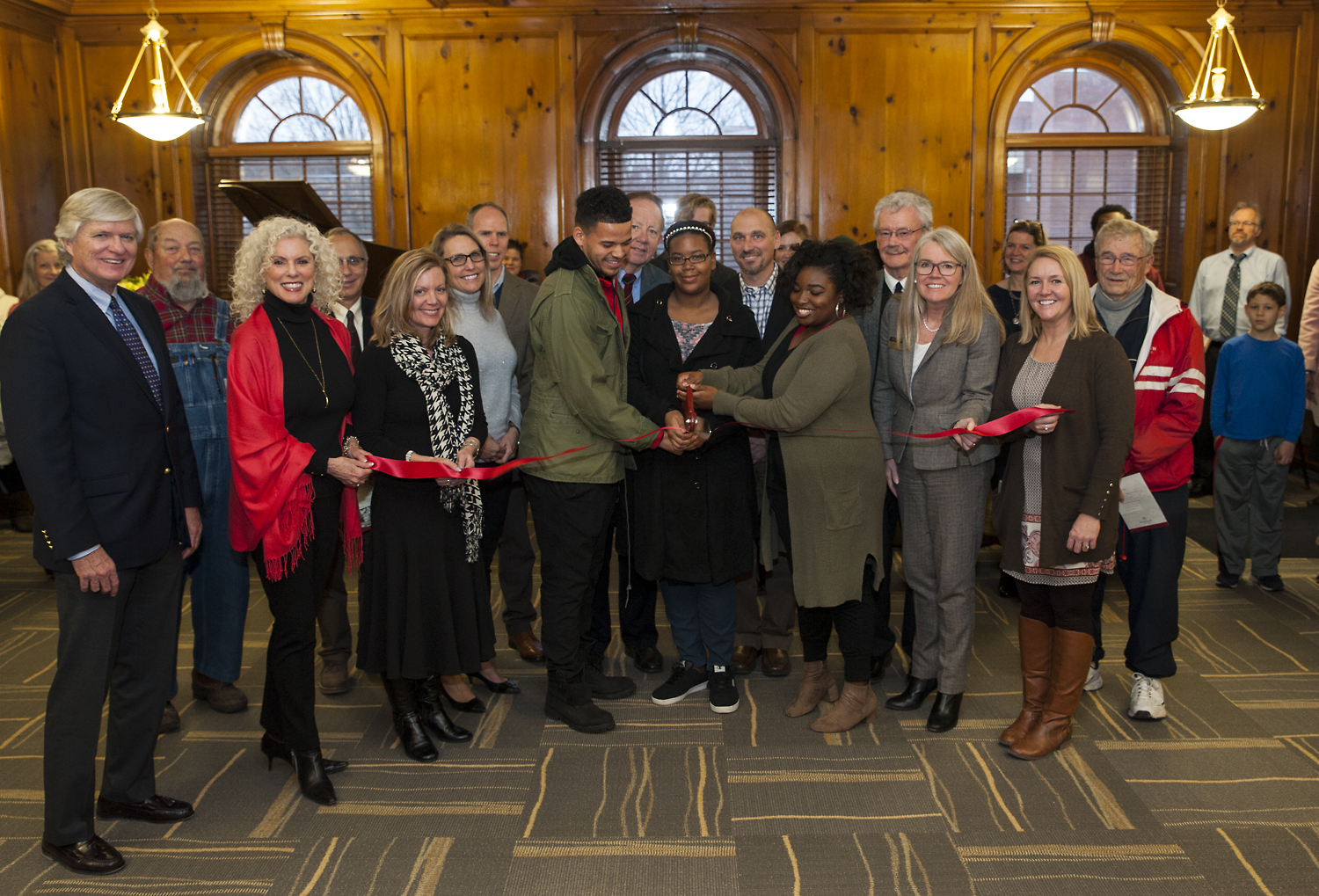
The third and final stop was the rededication of Grier Hall, a dormitory. This session included photos of rooms, a reception, and ribbon cutting. An on camera flash with a diffuser, bounced into the ceiling, was the main light. Most all photos were made with short zoom lens. Always looking for detail shots, I found one that helped tell the story of the event. Two photos from this session are included here.

"Farewell, President Bush"

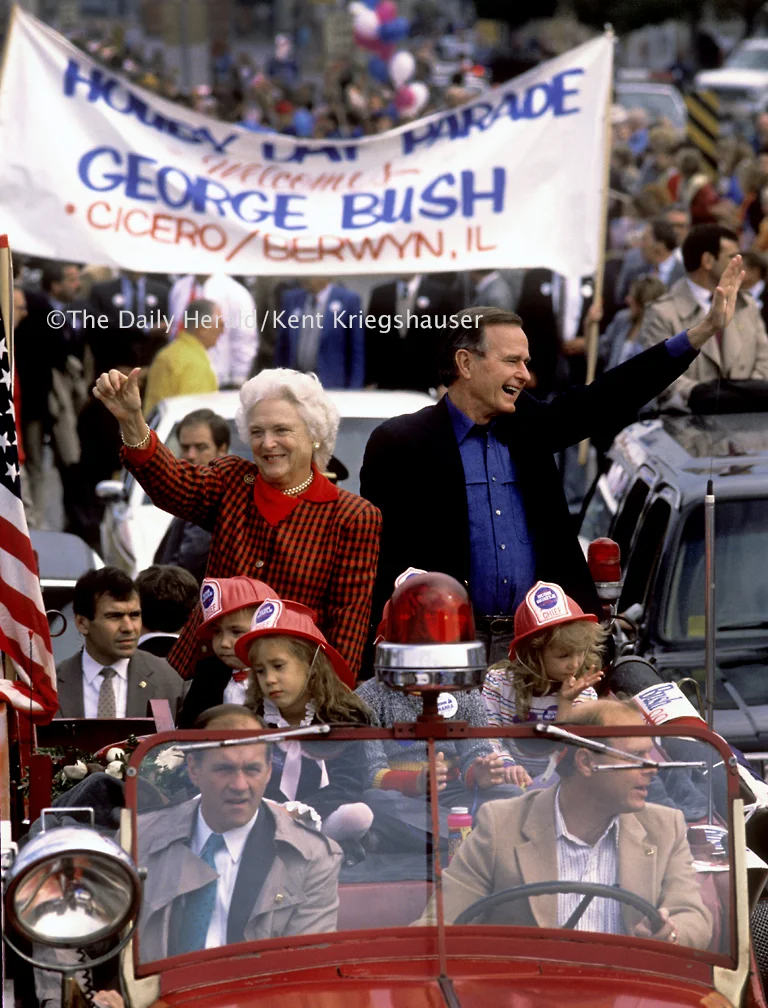
October 10th, 1988. I'd forgotten the town until I saw the banner. Berwyn, IL. I was working for The Daily Herald. The photographers were on the back of a flat bed truck, running just ahead. I'm guessing a 180mm lens? Maybe the 300mm? Definitely a color transparency.

George H.W. Bush.jpg

"A Knight One Day"

Stumbled upon a "30 For 30" about Bobby Knight. As a staff photographer for The National Sports Daily, I was dispatched to Bloomington, IN to make a portrait of Calbert Cheaney. Someone at The National set it up through the Indiana SID. A pre-practice portrait. Though this session was planned, I'd been warned coach Knight was moody, and could make my drive from Chicago a wasted one. Cheaney was quiet, polite, and did anything I asked. The session ran maybe 20 minutes. I went about my business but felt Knight's glare and impatience a time or two. This was 1991, the same year a couple of Knight's verbal tirades against his team were recorded and used in the "30 For 30" program. I got the portrait and got out alive.

Knight.jpg

"Hoops"

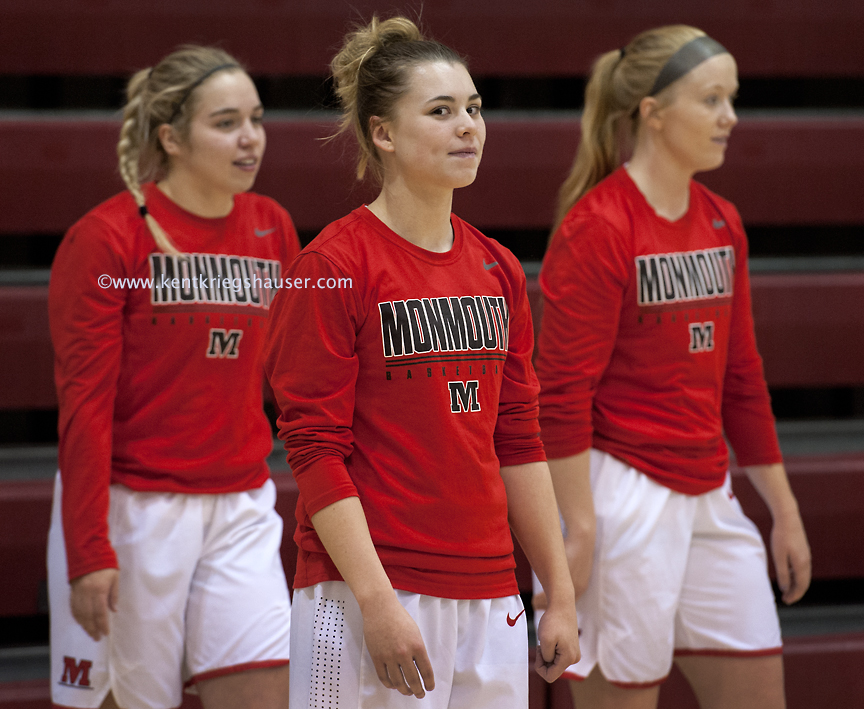
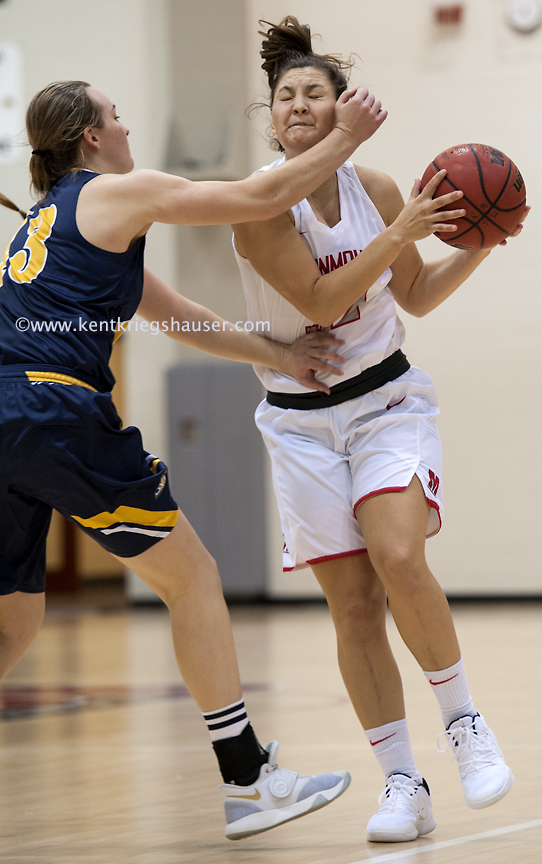
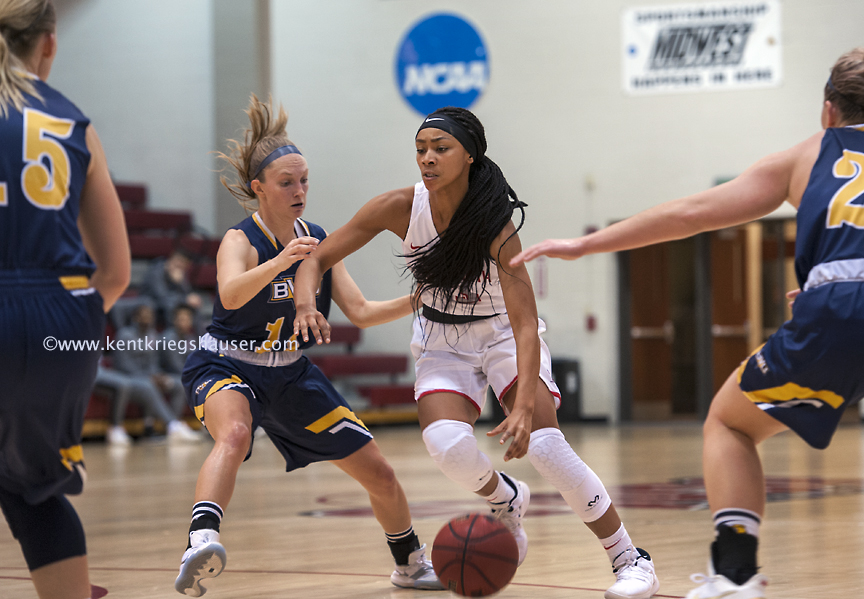
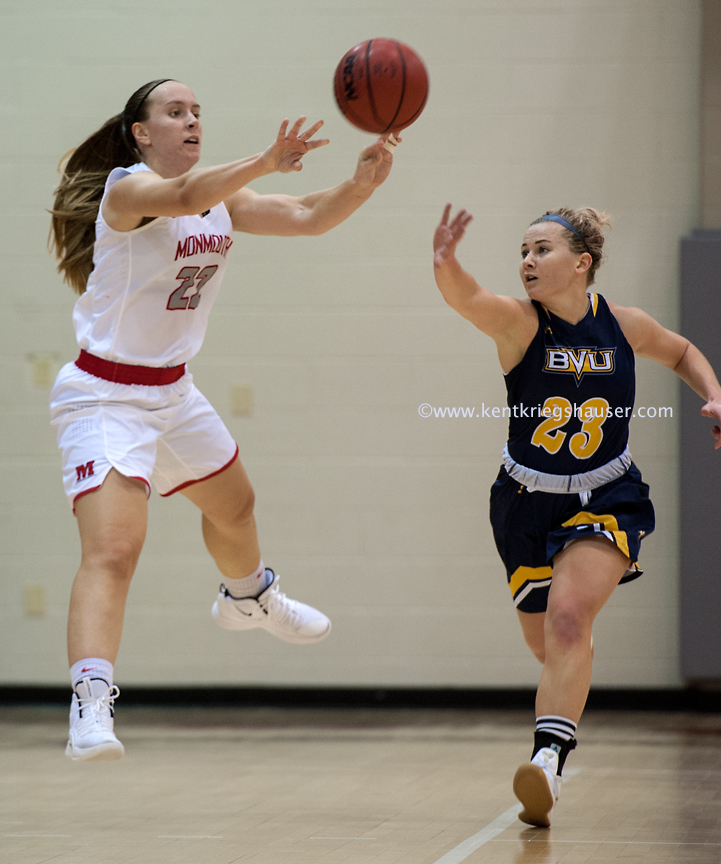
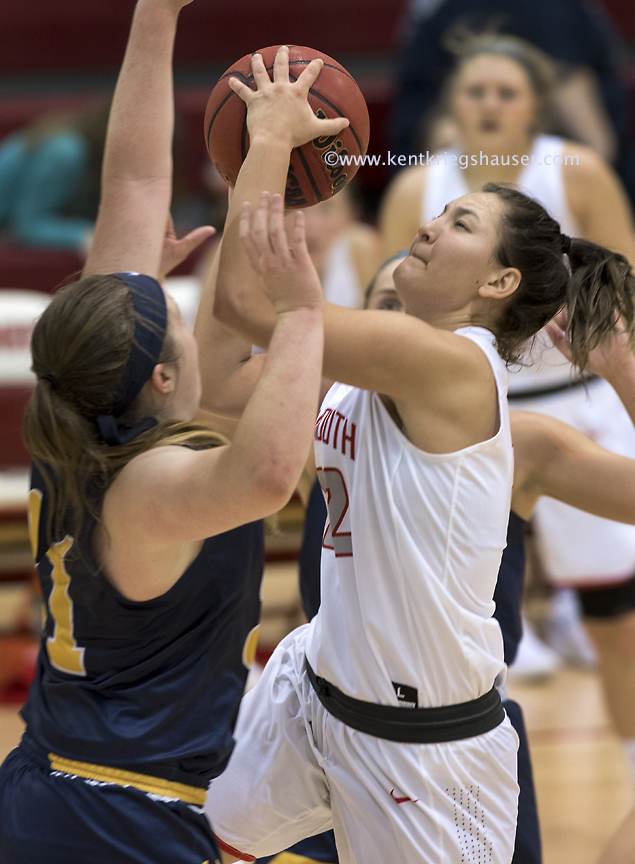
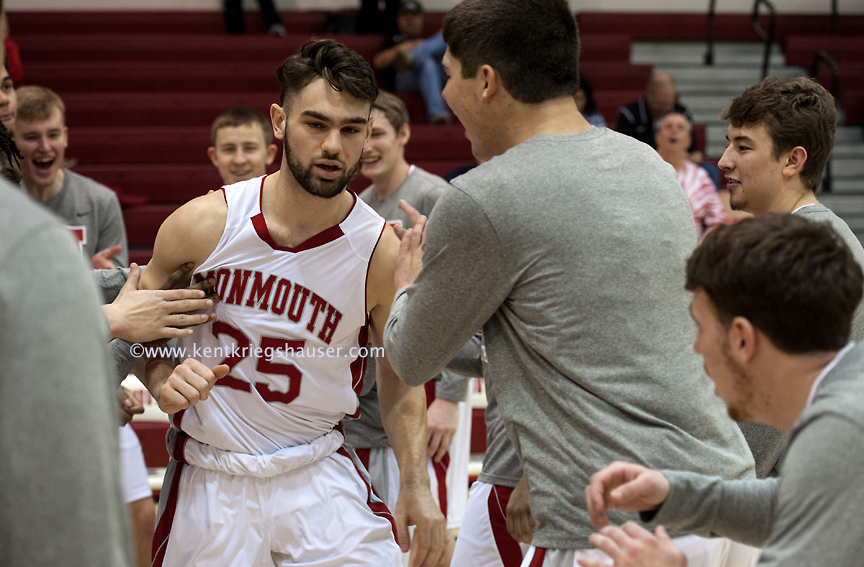
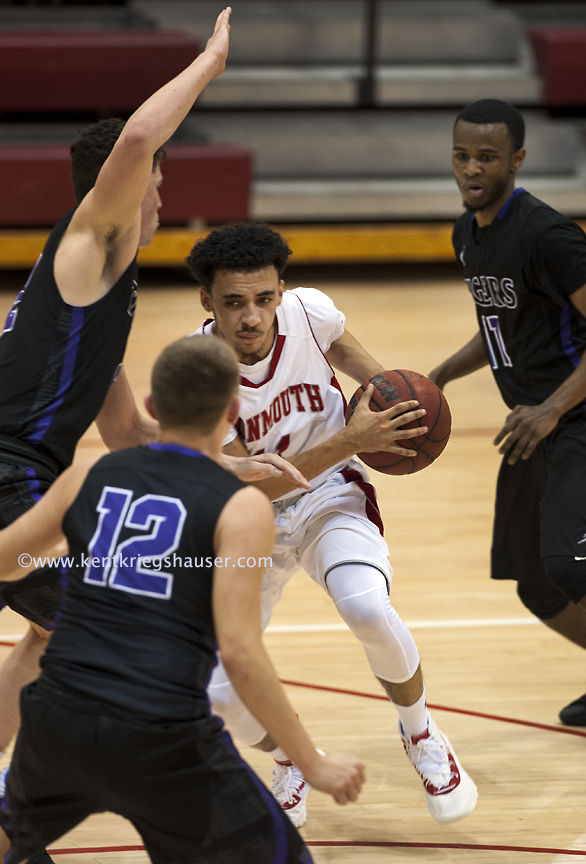
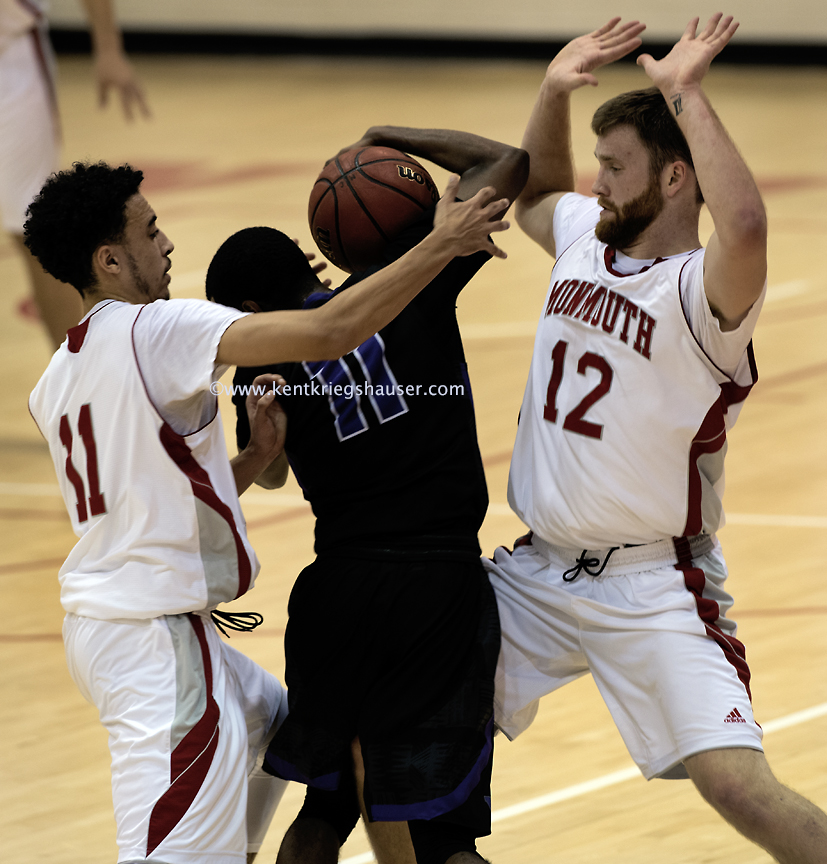
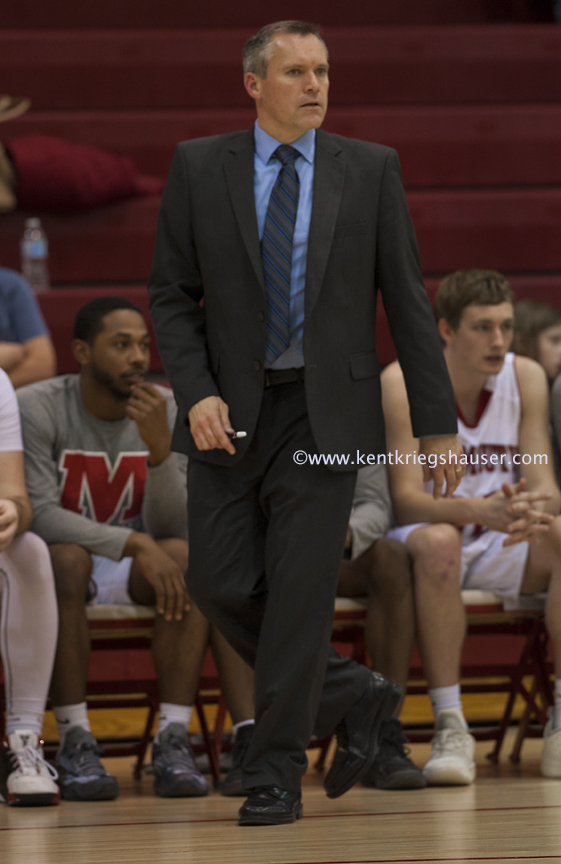
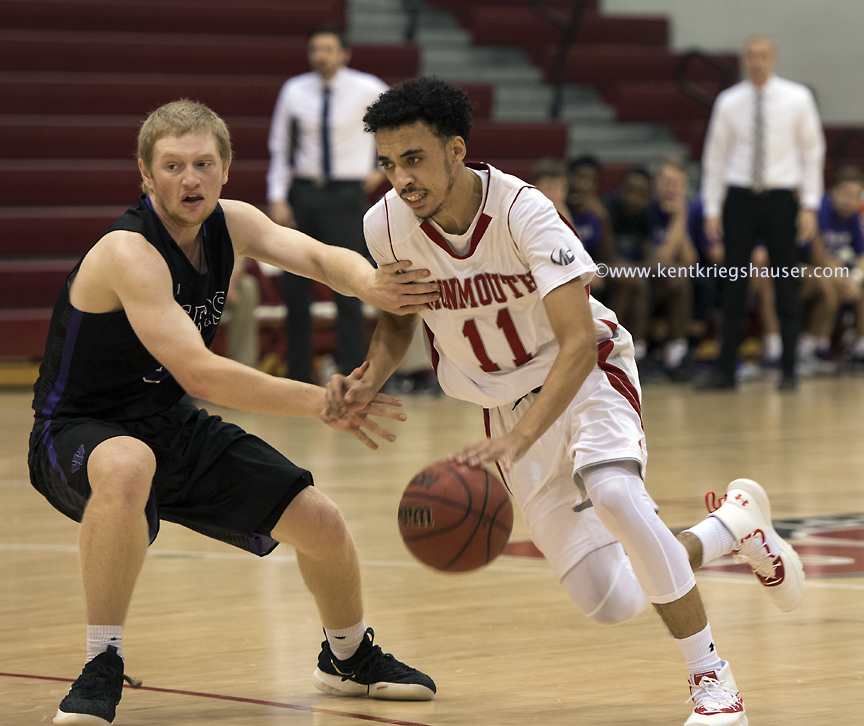
Saturday, November 24 marked the first time this season, to photograph basketball, or “hoops,” as we sometimes shorten it. I worked two games for my friends at Monmouth College. The ladies played Buena Vista College and won. The men came up just short against Iowa Wesleyan.

Basketball is not all that difficult to photograph. There is near constant motion. Plenty of chances to get “something,” whereas baseball and football usually have key or decisive moments. With basketball, one just hopes that something different may happen, and that one is in the correct position to capture it. Be it a dunk, scramble for the ball, or an excited coach or player.

I try and photograph basketball from different angles. My “go to” position is sitting along the baseline, just about where the three point arch line meets the baseline. An official may block you at times. But it’s a good spot. There are “overhead” positions, meaning slightly elevated from the floor. Usually the bleachers. Some arenas allow for positioning a remote camera in the catwalk, allowing for shooting down, directly over the rim. This allows for great rebounding shots. This is usually only an option at D1 and pro arenas.

The lighting in Glennie Gymnasium is really good. On par with those D1 and pro arenas. And, with digital cameras being able to handle the high ISO range that would have meant sacrificing quality in the film days, one can set the camera for almost any combination that suits the photographer. I still prefer to keep the ISO fairly low, but high enough to keep the shutter speed high. This prevents motion blur. For the two games Saturday, the cameras were set at 2000 ISO, the shutter speed at 1/500th, and the aperture ranged from f3.5 to f4.5.

I’m not sure what type the lights are in Glennie? They seem to be daylight balanced. That is, they don’t give off a color cast. Images straight from the camera don’t require much correction. But the lights do one thing that I’ve seen a handful of times in my career. They “cycle.” You can not detect this with the naked eye. You can not see this happening. But upon reviewing photos, one can see an ever so slight change in the color balance of the lights. Or also in the brightness/darkness. This can be eliminated by slowing the shutter speed, as the lights would “cycle” through. But slowing the shutter speed may mean blurry action. That’s not good unless that is the goal.

When I work for colleges, I’m usually asked for action photos, as well as watching for as many player profile or feature photos I can make. Especially key players. Coaches and fan reaction are also important. One has to be very aware and anticipate what is happening, or may happen. This is true in almost all sports photography.

What has changed the most in my shooting style, when it comes to basketball, is the format. Basketball is an “up and down” sport for the most part. head to toe, vertical format. But with social media ruling the day, this means shooting 90% in the horizontal format to match web sites, hoping something may be cropped vertical. I find it very frustrating. It’s a real challenge. But it’s a sign of the times. I’m the “pro,” I’m to work around it.

I did notice one other change on Saturday. Me. I’m almost another year older. Getting up and down, and off the floor, is more difficult!

"Back to Blogging"

Hello! The blog is back. I was very inconsistent in blogging (non-existent but for one original post) when I created this web site a few years ago. Eventually, it was deleted from this site. The new goal is to make shorter but more frequent blog posts, regarding all aspects of my photography work.

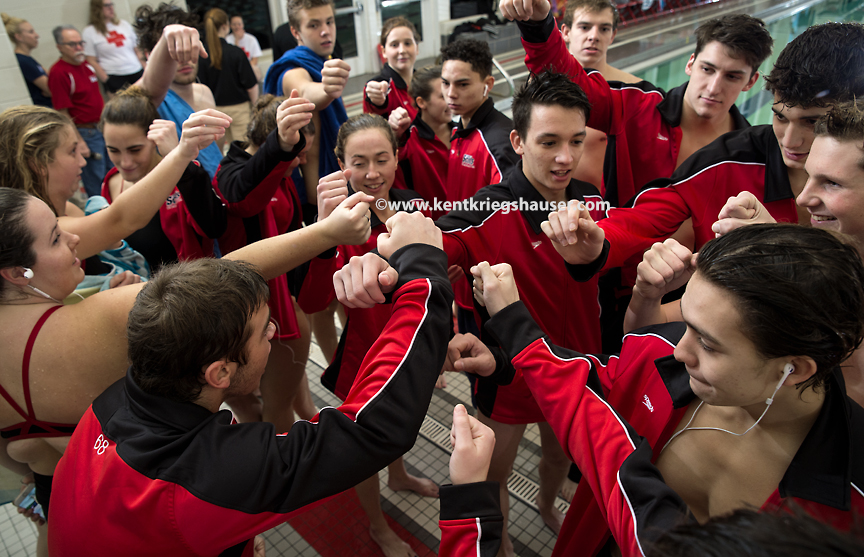
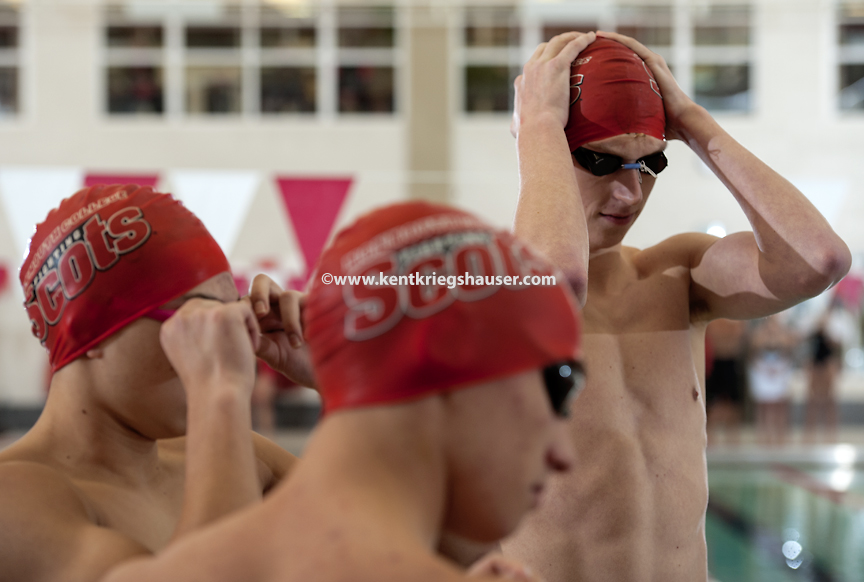
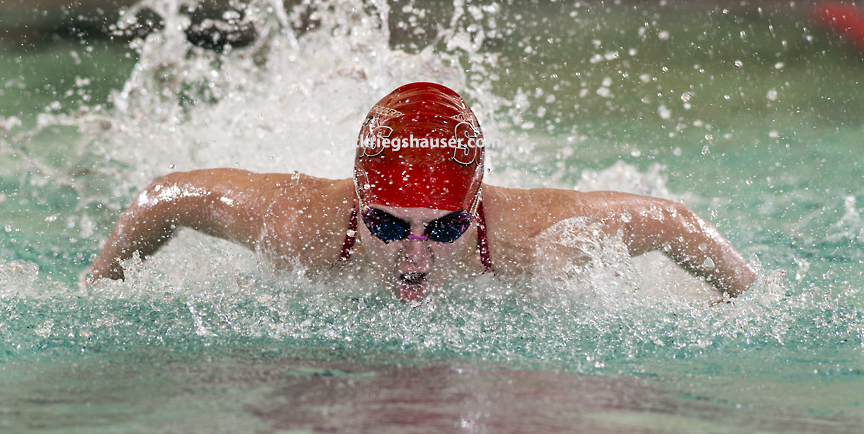
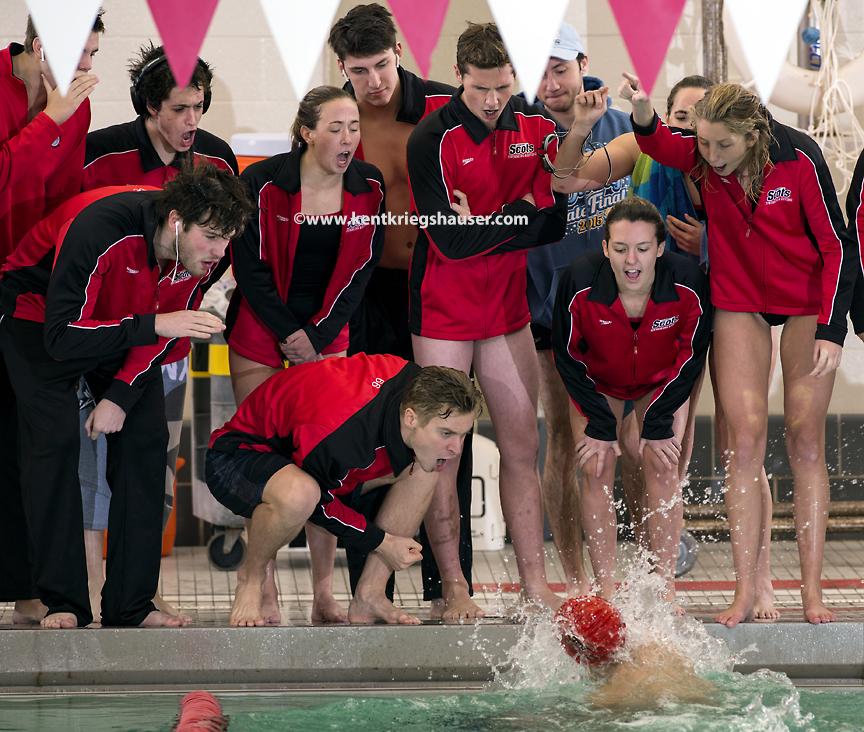
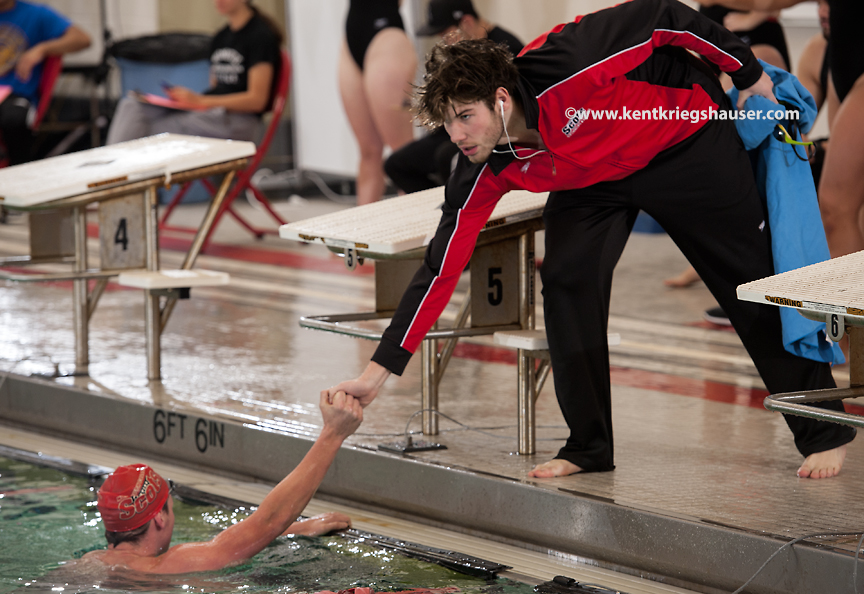
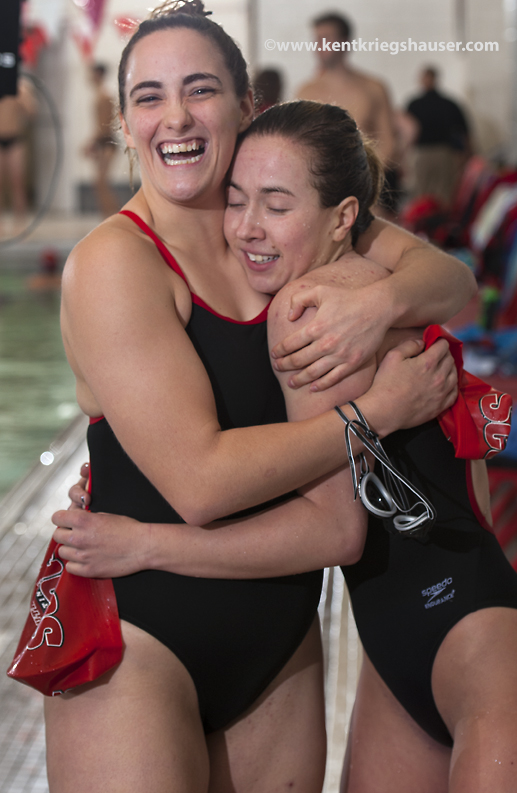
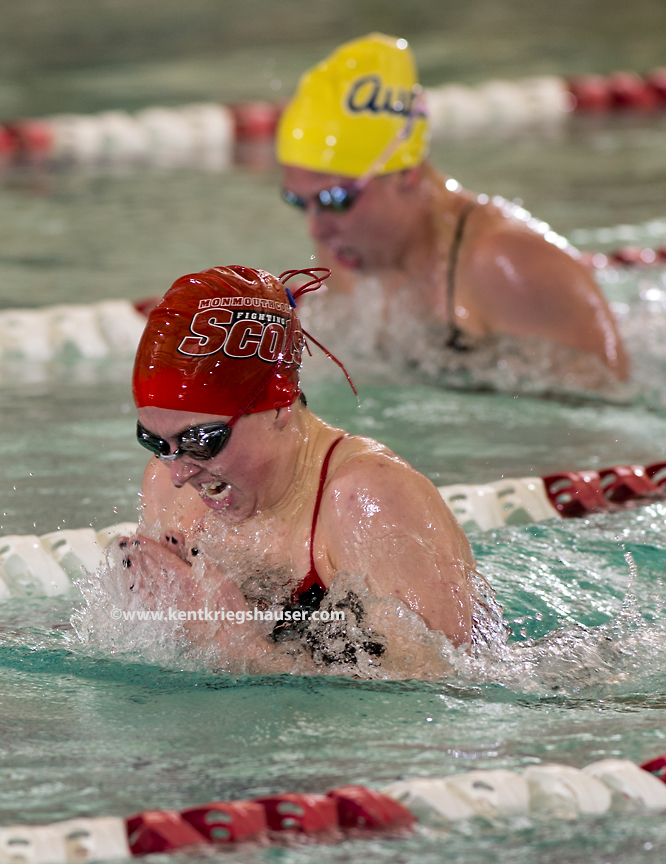
So. With that in mind. Here are 10 photos from recent work done for Monmouth College. Monmouth College Vs. Augustana College swimming. November 16th, 2018