
Harvest season is winding down. It’s a camera, not a combine, I use, but I’m observing more open fields than standing corn or beans lately. I’m told it’s a good crop this year. Spring planting, fall harvesting. A cycle for all farmers, some of them for generations.
Ten years ago, Wataga resident Michael Robson approached me, asking if I’d be interested in documenting a project for him and his family. I’ve known Michael from my very first days in Galesburg as a photographer at the Register-Mail newspaper. Michael was the athletic director at Galesburg High School. He and his two brothers, David and Dan, were sons of a farmer. Their father, John, was a second generation, maybe third generation, farmer. It was not uncommon to spot John and his wife Chey at the local DQ on Thursday evenings.
Michael lives in the house his dad grew up in on the farm property, His mom and dad had built a ranch style home just across the fields. The two brothers live away from this area. All three men had found, or chosen, different career paths than their dad. At some point, everyone in the family knew the string would end with John.
The timeline moved up, not by choice, when health issues crept up on John. He was 83 years old in the fall of 2015 and had been going strong before.
Michael’s idea was for me to make trips to the farm at various times and days, and make photos of whatever was going on. They would be bringing in corn and soybeans with the help of hired hands, Dick Kelly and Larry Lytle. For four years previous to 2015, Michael was an integral player in the planting and harvest seasons, very involved in the farm operations.
I jumped at the chance to do the work. Stories are the backbone of photojournalism, a chance to expand. Greg Mellis, a friend, great photographer, editor, and now owner of a paper, said this. “I don’t care about singles (one photo), anyone can get lucky. I wanna see stories. They tell me how you think.” A typical story has a “lead” photo, a “closer", and a few in between. Detail shots are important too. In the newspaper business, a story was usually limited to four-six photos due to space. In the digital age, with galleries, space is unlimited. As a result, redundancy in content is a risk. “Every photo should tell you something different,” I’ve been told.
Michael and I communicated on when the best opportunities might be for photos. I had some ideas too, wanting to make sure I caught daylight and nighttime hours, key moments, etc. To tell the story!
The first day for photos was September 30th. I’d never met Dick or Larry before but jumped right in. All four men quickly grew comfortable with me around. The guys acted like I wasn’t around, which is exactly what a photographer hopes for, to capture real moments. There were staged portraits as well.
The further into the project, the more varied it became with situations and emotions. Larry and I were atop a grain bin when the wind blew his hat off his head. John once crouched down, mirroring and mimicking me as I had lowered myself for an angle of him near a combine. John and Micheal stood by a grain cart for me. The portrait was posed, the positioning was not. The cart brand was J&M, the initials of the father and son! In looking back, Michael has noted that in nearly all photos, Michael is walking to his dad’s left, and they are walking in near unison.
Every day, John drove his pickup truck across the fields to have lunch with Chey. I knew this could be a very important photo for the story. Realizing as well, that it was a private moment for the Robsons. A photographer is only as good as the access they are given. Access is earned by trust. I explained how much of lasting impact the photo would have. I sensed only a second of thought and hesitation before I was told I could follow John to the house. I worked quickly and quietly. I feel the story would be weaker without it. When Michael had books produced, allowing me to lay out the photos, I ran it across two pages of the book. A “double truck” it’s referred to in the publishing business.
The last day came. Dick and Larry were on hand, standing nearby, when Michael and his dad, both in the cab of the combine, took out the last of the corn. What we wound up calling “The Final Harvest” was complete.
John Robson passed away the following spring. His passing brought to mind coach Bear Bryant and Peanuts cartoon creator Charles Schultz, who died one day after the last cartoon strip published. A man has to have a sense of purpose. John Robson’s was farming. A slide show of many photos from the harvest played at his visitation, helping tell of John’s life.
Mrs. Robson and Larry Lytle have also passed since this project.
Seven trips and a combined 12 hours were spent at the farm. Just under 2,000 photos were made. Michael has told me many times, he’s so glad he had me do the project. It was an honor and privilege to work with five fine people.
Photos have SO much impact! It’s important to document and preserve memories. If you have a farmer, a butcher, baker, or candlestick maker in your life, I’d love to do more of these stories/projects.
“A picture’s worth a thousand words.” Below are 24 that tell the story better than I can.

Wataga, IL farmer John Robson in the fall of 2015. John is standing near his favorite location, able to see all points of the land.

One of the very first photos made for the project. From left, Larry Lytle, Dick Kelly, John Robson, and his son, Michael Robson.

Corn harvest.

John Robson operates a combine during the fall harvest of 2015.

Dick Kelly, Larry Lytle, and Michael Robson, from left.

Larry Lytle, left, and John Robson, during a coffee break.

Michael Robson in the kitchen of his home. A sketch of the farm hangs behind him.

John and Michael walk the property.

Soybeans in the early evening light.

Michael Robson takes his turn in the combine near sunset.

Work doesn’t stop when the sun does.

Mr. John Robson.
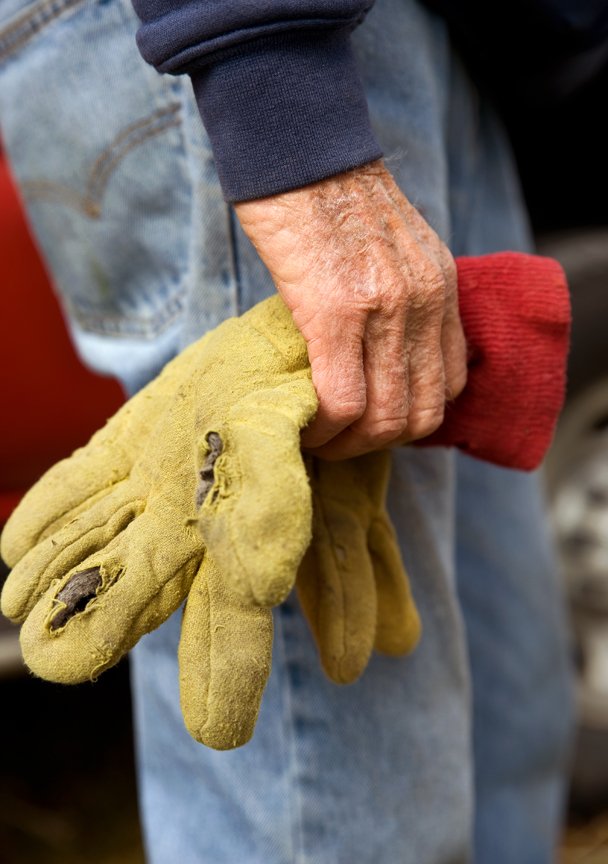
The hands and gloves of a farmer.

Michael walks with his father after John’s shift in the combine. It was lunchtime.

John and Chey Robson say Grace before lunch in their home.

Corn is emptied from a grain cart into an elevator grate.

John mimics the photographer, who had crouched for a lower angle as John got out of the combine.

John and Michael with a grain cart. Ironically, the brand name shares the initials of their first names.

A load of corn arrives from the fields.

Michael and John. Two generations of men and tractors.

Dick Kelly, left, and Larry Lytle stand nearby as Michael and John, run the combine through the last few rows of corn.

Michael and John harvest the last of the corn, completing the 2015 harvest at the Robson farm.

Michael Robson, left, and his father, John.

The last pair of boots and gloves of Wataga farmer John Robson