
“Imitation is the sincerest form of flattery.” That’s a quote from Oscar Wilde.
I began seeking out Rolling Stone magazine in the summer of 1975 to follow The Rolling Stones massive U.S. tour. I was 16 years old and packing a new, Minolta SRT 101 camera, beginning my quest to become a professional photographer. The photos of the tour by RS staff photographer Annie Leibovitz had a huge impact and influence on me. I became a big fan of her work, rightfully so. She was great. A genius with concepts.
Fast forward to June of 1984. A portrait of Boy George and Culture Club caught my eye on the cover of the magazine. It was Annie’s. “Oh, that’s kinda cool,” I thought to myself. “Great idea.” That portrait of the band stuck with me, in the back of my mind. What is it they say? Something about how we accumulate thoughts, ideas, etc, like lint.” The portrait became “photographic lint.”
If they are honest, I’d bet any photographer would tell you how they were influenced by another photographer along the way. By one or more “shooters” who came before them. The payoff, once one gains enough experience and develops their own style, is to learn that yourself influenced someone coming up behind you. Tom Grieger, who was the Director of Photography at The Daily Herald when I worked there, said, “There’s nothing new under the sun. Everything has been shot. It’s all about how you make it look new again.” I can speak only for myself, I have never meant to directly steal an idea, but I have certainly emulated some.
Fast forward again, to December of 1991. I was working at The Daily Herald at its bureau in Lisle, IL in DuPage County. The paper was making a huge push to increase circulation in a rapidly growing area. The prep sports department in DuPage was second to none, strong! The editors “turned the dogs loose” in terms its use of photography. Photos got huge play, which photographers love.
Waubonsie Valley High School in East Aurora was in the circulation area. I was dispatched to photograph three brothers, all wrestlers, for the high school. I arrived, was taken to the practice area, was introduced, and we began working. I can’t remember for sure, but I believe I was told in advance that the story and photos would lead the section. I knew I had to come up with something better than usual. “Do the best you can and don’t screw up,” we used to joke. “Failure is not an option, we can’t publish excuses,” Mr. Grieger would say. Both quotes rang in my head.
I had time to work with the brothers. We tried few things. I did not have any wireless flash triggers back then, but I did carry three Nikon SC-17 cords in my camera bag. Flash cords, which enabled one to shoot with off camera flash. One end attached to the hot shoe of the camera, the the other to the flash. By tethering the three together, I could place a flash on a stand (or have someone hold it) 6-10 feet away. I also had a couple of Wein Peanut slave units (triggers a second flash when the first one fires)
At some point in the session, Annie’s Culture Club portrait came back to me. The brothers were good-natured and went along with the idea when I showed them what I had in mind. I placed the oldest brother in the position to put his younger siblings in the “headlock,” something synonymous with wrestling.
The primary light was the one with the cords, using a piece of cardboard to bounce and soften the light. The second light (with the peanut slave) was placed to the right, one stop brighter and with no bounce, to give the accent light on the hair and cheek of the older brother.
Joe Bush wrote the story. And there you have it.
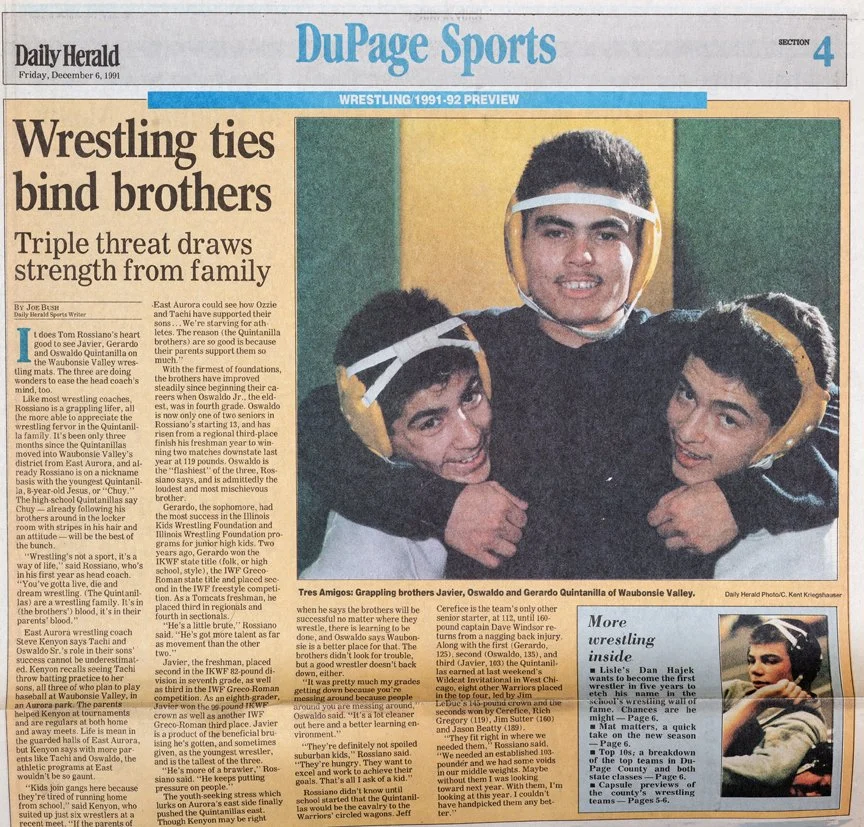
The Quintanilla brothers. Waubonsie Valley High School wrestlers. From December 1991
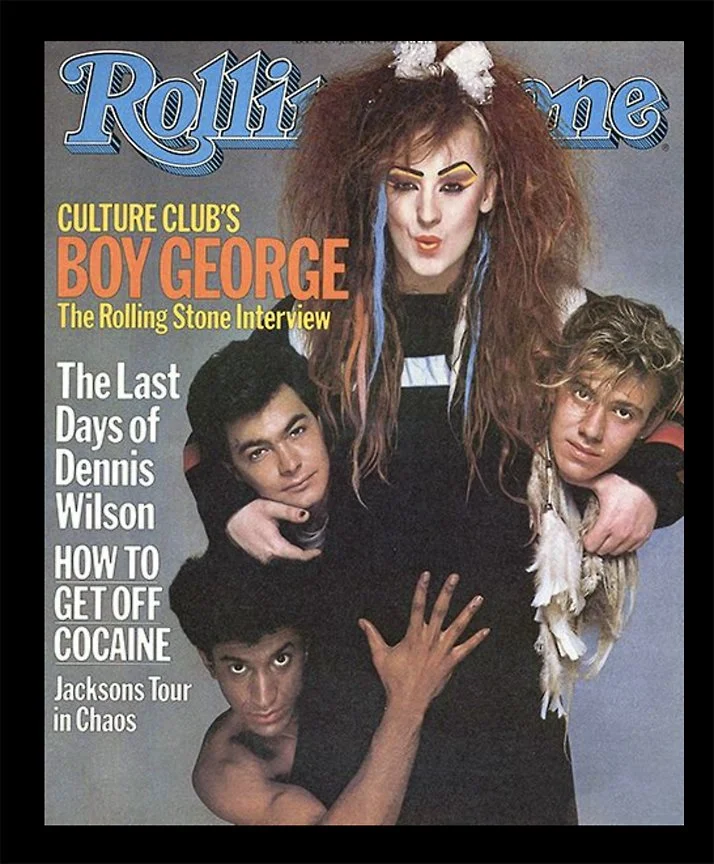
The portrait that influenced me to make the wrestling photo. PHOTO CREDIT: Annie Leibovitz/Rolling Stone magazine.